

For small insects such as jumpers, fleas and planthoppers, needles should not be inserted directly, but special methods should be used.
1.Double interpolation
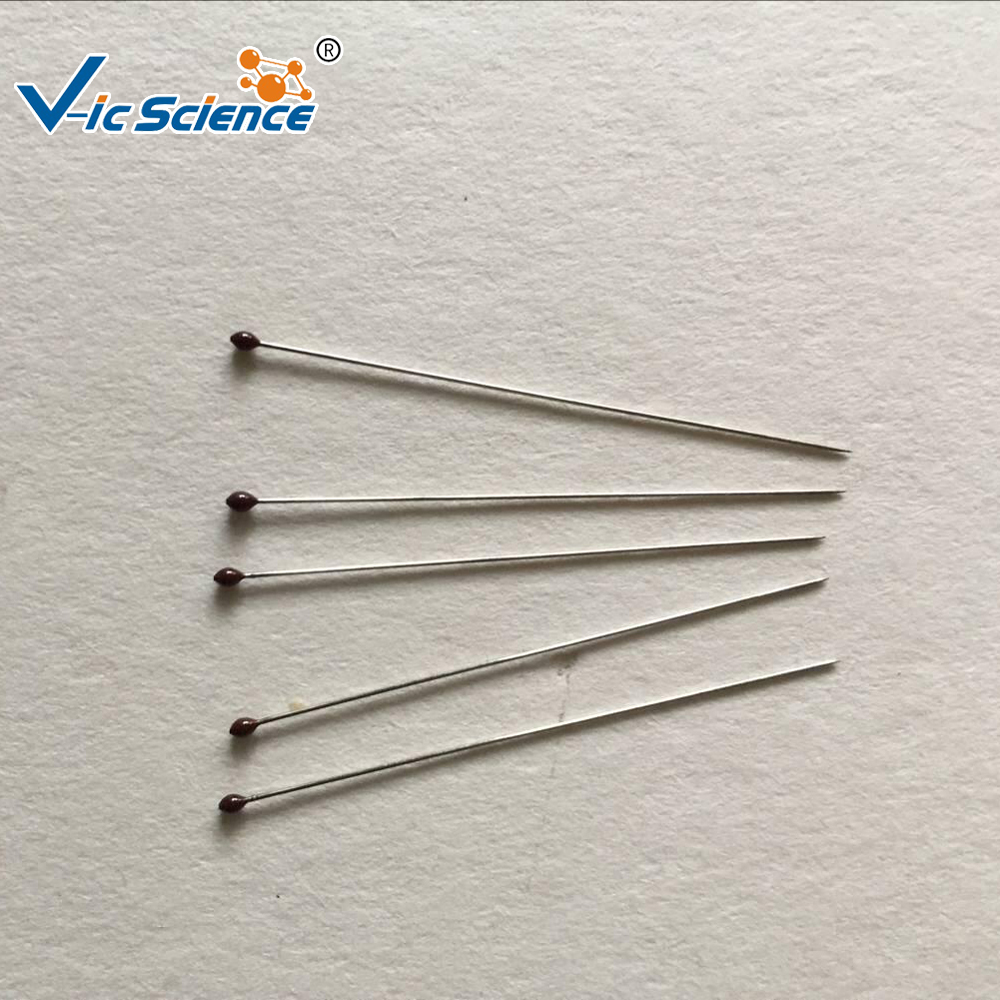
The needle size 00 is thin and short, with a sharp tip and no needle cap. It is specially used to puncture small and hard insects. The insect body was picked up with small forceps, and the specimen was punctured vertically with microneedle according to regular needle position, and inserted on a small triangular cork block or hard paper. Then insect needles above No. 1 were inserted near the bottom edge of the triangular paper, and then the insect position was fixed with a three-stage stage. The specimen and label inserted were located on the left side of the insect needle.
2.Worm interpolation
Cut the cardboard into a small isosceles triangular card with bottom edge length of 0.4cm and height of 1cm. Dip the tip of an insect needle into latex and gently point it on the tip of the triangular card. Then glue the insect body with the tip of the needle and place it on the latex, and quickly withdraw the needle to avoid picking up the insect body. The key point of this operation is that there should not be too much latex on the tip of the needle. If the glued specimen needs to be upright, the insect tip can be used to stir it. Finally, the insect needle can be inserted near the bottom edge of the triangle film, and the insect position can be fixed with a three-stage stage, and the label can be inserted into the specimen box for long-term storage.