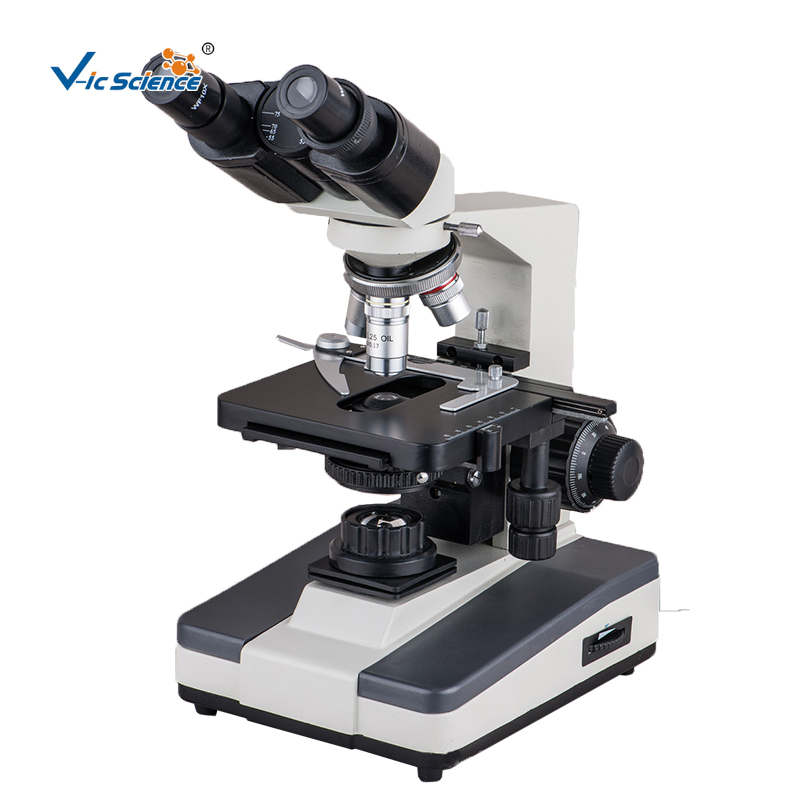
With the development of science and technology, people find it inconvenient and awkward to observe with one eye, so binocular microscope is born, that is, two eyes observe at the same time, and there is also a three eye microscope. The third eye is usually used to connect video imaging equipment, that is, take pictures under the microscope and save them. Binocular microscope is an indispensable precision instrument for scientific research, teaching, medical treatment, health and so on.
Microscope lens body (the lens body includes: XY mobile stage, objective turntable, focusing mechanism, aperture light bar and field light bar) 2 Binocular tube 3 Light source 4 Eyepiece 5 Objective lens 6 carrier plate 7 Color filter.
By a common primary objective lens, the two beams of light after imaging the object are separated by two sets of intermediate objective lenses - zoom lenses, and form an integrated angle of view, and then imaged by their respective eyepieces. Its magnification change is obtained by changing the distance between the intermediate lens groups, so it is also called "zoom stereomicroscope". With the requirements of application, binocular stereomicroscope can be equipped with a variety of optional accessories, such as fluorescence, photography, camera, cold light source, etc.
The object image system seen from the microscope is magnified twice. After the optical path and amplification of the microscope, the balanced light of the light source reaches the reflector, and is reflected by the reflector into the concentrator. The specimen is focused and illuminated by the condenser. This light enters the objective lens through the front focus of the objective lens, and then spreads upward through the rear focus to form the inverted real image of the first magnification. It falls on the focal plane in front of the eyepiece and enters the eyepiece to form a second amplified orthostatic virtual image. The second magnified image seen by the human eye at the sight distance in front of the microscope.
Microscopes show a new world in human vision. For the first time, people see hundreds of "new" micro animals and plants, as well as the internal structure of everything from human body to plant fibers. Microscopes also help scientists discover new species and help doctors treat diseases.